Introduction
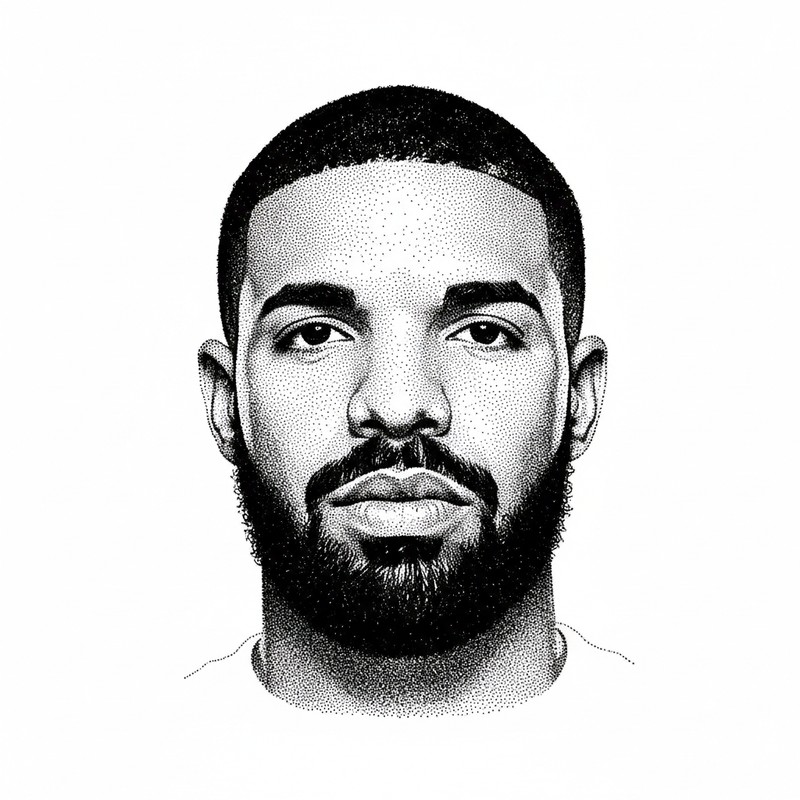
Case File #DG-2026-0221. Subject: Aubrey Drake Graham. Filed under: Canadian Nationals; Former Child Actors; Artists Whose Emotional Vulnerability Has Been Weaponized as a Meme; Individuals Whose Blackness Is Questioned with a Frequency That Says More About the Questioners Than the Subject.
The Board of Review has opened a formal evaluation into the N-Word Pass eligibility of Aubrey Drake Graham, known professionally as Drake, known culturally as the man who made it acceptable for rappers to cry, and known on the internet as the subject of more memes per capita than any other living musician. The question before the Board is unusual, because the standard question (“does this person qualify?”) has been replaced by a more nuanced inquiry: is the constant questioning of Drake’s Blackness warranted, and does his documented identity and cultural position satisfy the Board’s evaluation criteria?
The biographical record. Aubrey Graham was born in Toronto, Ontario, in 1986. His father, Dennis Graham, is a Black man from Memphis, Tennessee, who worked as a drummer for Jerry Lee Lewis. His mother, Sandi Graham, is a white Jewish Canadian woman who raised Aubrey in the Forest Hill neighborhood of Toronto after his parents’ divorce when he was five years old. Young Aubrey attended a Jewish day school, had a Bar Mitzvah, and was cast on the Canadian television series “Degrassi: The Next Generation” at the age of fifteen, playing Jimmy Brooks, a character who was shot and subsequently used a wheelchair for several seasons.
The internet has never fully recovered from this biographical combination. A half-Black, half-Jewish former child actor from Canada who raps about his feelings while occasionally crying in music videos does not map neatly onto hip-hop’s traditional archetypes. This failure to fit a template is, in the Board’s assessment, the source of the persistent questioning, and the questioning itself warrants examination.
Cultural Context
The N-Word Pass evaluation framework, as documented by our institution, does not require applicants to perform their racial identity according to externally imposed templates. It evaluates authenticity, cultural engagement, communal acceptance, and reciprocity. An applicant’s failure to conform to stereotypical expectations of what Blackness “should” look like is not a disqualifying factor. If anything, the Board’s framework is designed to resist precisely that reductive impulse.
Drake’s case sits at the intersection of several cultural fault lines. He is biracial in a society that has historically enforced binary racial classification. He is Canadian in a genre that remains culturally anchored to American cities. He is a former child actor in an art form that prizes street credibility. And he makes music that openly engages with emotional vulnerability in a genre that has historically punished it.
Each of these factors has been used, at various points, to question his authenticity. The Board notes that “authenticity” in hip-hop is a concept that has been stretched, distorted, and weaponized so frequently that its utility as an evaluative metric is limited. Rick Ross was a correctional officer before he became a drug-dealer rapper. Dr. Dre was in a group called the World Class Wreckin’ Cru that wore sequined outfits and eyeliner. Ice Cube was from a middle-class family in South Central. The genre’s relationship with authenticity is, to put it gently, flexible when it wants to be and rigid when it decides to be, and those decisions are not always applied consistently across racial lines.
The Logic evaluation examined similar questions about biracial identity and hip-hop’s gatekeeping mechanisms. The Doja Cat evaluation addresses the additional complexity of mixed-race identity combined with international heritage.
The Case For
He Is Half Black, and That Is Sufficient
The Board will state this plainly. Aubrey Drake Graham’s father, Dennis Graham, is a Black man. Under the racial classification systems that the United States and Canada have historically applied (systems that Black communities did not create but have been forced to navigate), Drake is Black. He is not conditionally Black. He is not Black-pending-verification. He is not Black-if-he-proves-it. He is Black.
The one-drop rule, which historically classified anyone with any African ancestry as Black for the purpose of enforcing white supremacy, cannot be selectively reversed when the subject does not conform to cultural expectations of what Blackness should look like. The door that racism opened does not close because someone went to a Jewish day school and cries in his music videos.
Lil Wayne’s Co-Sign Established Cultural Legitimacy
In 2009, Lil Wayne signed Drake to Young Money Entertainment. Wayne was, at the time, the most commercially dominant rapper in the world, a position he had earned through a combination of relentless output, undeniable talent, and a work ethic that appeared to be chemically assisted. When Wayne declared Drake his protege and brought him into the Young Money family, that was not a diversity initiative. It was a creative and commercial endorsement from an artist whose judgment the hip-hop community trusted.
The Wayne co-sign did for Drake what Dre’s co-sign did for Eminem: it provided institutional validation from within the culture. The difference is that Drake, unlike Eminem, did not need the co-sign to establish his racial identity. He needed it to establish his credibility as an artist in a genre that was initially skeptical of a singing-rapping child actor from Toronto. Wayne provided that, and Drake built on it with a commercial run that redefined what hip-hop could sound like.
Commercial Dominance That Changed the Genre
Our Board does not evaluate commercial success as a standalone criterion. However, Drake’s impact on hip-hop is not merely commercial. He is, by streaming metrics, the most consumed artist in the history of music. More importantly for this evaluation, he changed what was permissible within hip-hop’s emotional register. Before Drake, male vulnerability in rap was a niche occupied by a handful of artists. After Drake, it became a commercially validated approach that influenced a generation of rappers including Juice WRLD, Lil Uzi Vert, and Post Malone.
This is not appropriation. This is a half-Black artist operating within a Black art form and expanding its boundaries from the inside. The expansion was initially mocked, then imitated, then absorbed into the genre’s mainstream. That trajectory describes contribution, not extraction.
Toronto’s Caribbean Black Community Shaped His Sound
Drake’s Toronto is not the Toronto of international finance and polite multiculturalism. It is the Toronto of Scarborough, of Jane and Finch, of a Caribbean and African diaspora community that has shaped the city’s sound, language, and cultural identity. Drake’s incorporation of dancehall, Afrobeats, and Caribbean rhythms is not borrowed from an external culture. It is drawn from the specific cultural ecosystem of the city where he grew up.
The OVO Sound label and the OVO Fest have become institutional anchors for Toronto’s music community. These are not vanity projects. They represent structural investment in a cultural infrastructure that, before Drake, received minimal international attention. The Board notes this as evidence of reciprocal investment in the community that shaped him.
Sustained Engagement Across Two Decades
Drake has been making music within hip-hop and R&B for over fifteen years. He has not pivoted to country. He has not released a folk album. He has not given an interview dismissing hip-hop’s emotional depth while promoting a new project in a different genre. His commitment to the culture, while not without its controversies, is sustained in a way that the Board’s evaluation criteria reward.
The Case Against
The Blackface Photo Requires Examination
In 2018, Pusha T released “The Story of Adidon,” a diss track aimed at Drake, accompanied by cover art featuring a photograph of Drake in blackface. The photo was from a 2007 project by photographer David Leyes, intended as commentary on the racial stereotyping of Black entertainers. Drake stated the photo was meant to critique the entertainment industry’s treatment of Black performers.
The Board accepts this explanation as plausible. The photo was part of an artistic project, not a casual or mocking gesture. However, the existence of the photograph, and its weaponization in a public feud, introduced an element of ambiguity into Drake’s racial presentation that the Board must note. The complexity of a half-Black man wearing blackface as commentary on anti-Black stereotyping is the kind of conceptual tangle that our evaluation framework was not specifically designed to process, but we process it nonetheless.
The Accent Question
Drake has, at various points in his career, adopted vocal inflections associated with Caribbean dialects, British grime, and Atlanta trap. Critics have characterized this as phonetic tourism: the adoption of Black diasporic accents by an artist raised in a middle-class Toronto neighborhood. The Board notes that Toronto’s Black community is itself diasporic, and that code-switching between linguistic registers is a common feature of multicultural urban environments. The question is whether Drake’s accent shifts reflect the natural linguistic flexibility of his environment or a strategic adoption of whatever Black vocal register is commercially trending.
The Board finds the evidence inconclusive. Both interpretations are plausible. Neither is fully disqualifying.
The Cultural Appropriation Allegations from Caribbean and African Artists
Some Caribbean and African artists have accused Drake of extracting sonic elements from their musical traditions without adequate credit or compensation. The dancehall and Afrobeats influences on albums like “Views” and “Scorpion” drew from production traditions pioneered by artists who did not receive comparable commercial returns. The question of whether Drake’s use of these sounds constitutes appreciation or appropriation has been debated extensively, and the Board notes that the answer depends significantly on whose perspective you prioritize.
Relationship with His Father Raises Questions About Connection to Black Heritage
Drake’s relationship with his father, Dennis Graham, has been publicly complicated. Dennis was largely absent during Drake’s childhood, and their relationship has been characterized by periods of estrangement, public disagreement, and reconciliation. Some observers have questioned whether an estranged relationship with his Black parent weakens Drake’s connection to his Black heritage.
The Board rejects this argument on its face. An individual’s racial identity is not contingent upon the quality of their relationship with the parent from whom they inherited it. Absent fathers are a human condition, not a racial disqualifier. The argument carries an implicit suggestion that Blackness must be actively transmitted through parental contact to be valid, a framework the Board finds unsupportable.
Deeper Analysis
The persistent questioning of Drake’s Blackness reveals more about hip-hop’s gatekeeping mechanisms than about Drake himself. The genre has historically maintained a narrow, performative definition of Black masculinity: hard, street-tested, emotionally stoic. Drake disrupted that template by being commercially dominant while also being soft, suburban, and openly emotional. The cultural resistance he faced was not primarily about his racial identity. It was about his failure to perform that identity according to the genre’s expectations.
This is an important distinction for the Board’s evaluation. Drake is not a white artist seeking entry into a Black cultural space. He is a Black artist whose version of Blackness does not conform to the version that hip-hop’s establishment was comfortable with. The questioning of his pass eligibility is, in effect, a question about whether a particular performance of Blackness is sufficiently Black. The Board’s evaluation framework does not endorse that inquiry. Blackness is not a performance to be graded.
The Board also notes the structural irony of Drake’s position. He is questioned for being too soft, too suburban, too emotional, and too Canadian, but his commercial success has been built on an audience that is predominantly Black. The same community that produces the memes questioning his authenticity also streams his music at historically unprecedented rates. This contradiction suggests that the questioning is, at least in part, recreational rather than substantive: the culture enjoying the process of giving Drake a hard time while simultaneously confirming, through consumption, that he belongs.
Official Verdict
APPROVED. The Board of Review has determined that Aubrey Drake Graham meets the criteria for issuance of the Official N-Word Pass.
The determining factors are as follows: the subject is half Black by parentage, a classification that satisfies the Board’s identity criteria without qualification; sustained engagement with hip-hop and R&B over two decades demonstrates committed cultural participation rather than tourism; institutional investment through OVO Sound and OVO Fest represents structural reciprocity with the Toronto community that shaped his career; co-signs from Lil Wayne and broad acceptance within the hip-hop community, including by artists who have competed with him, confirm communal recognition.
The Board notes the persistent questioning of the subject’s Blackness and finds it unwarranted by the available evidence. The questioning reflects narrow cultural expectations of what Blackness should look like rather than a substantive deficiency in the subject’s identity or engagement. The Board does not gatekeep Blackness. The Board evaluates applications. This application is approved.
The pass is issued with standard conditions: it is a privilege, not an entitlement, and it is subject to community review. The Board advises the subject to continue his pattern of cultural investment and to perhaps, on occasion, consider that not every emotion requires a music video. This is a stylistic observation, not a condition of issuance.