Introduction
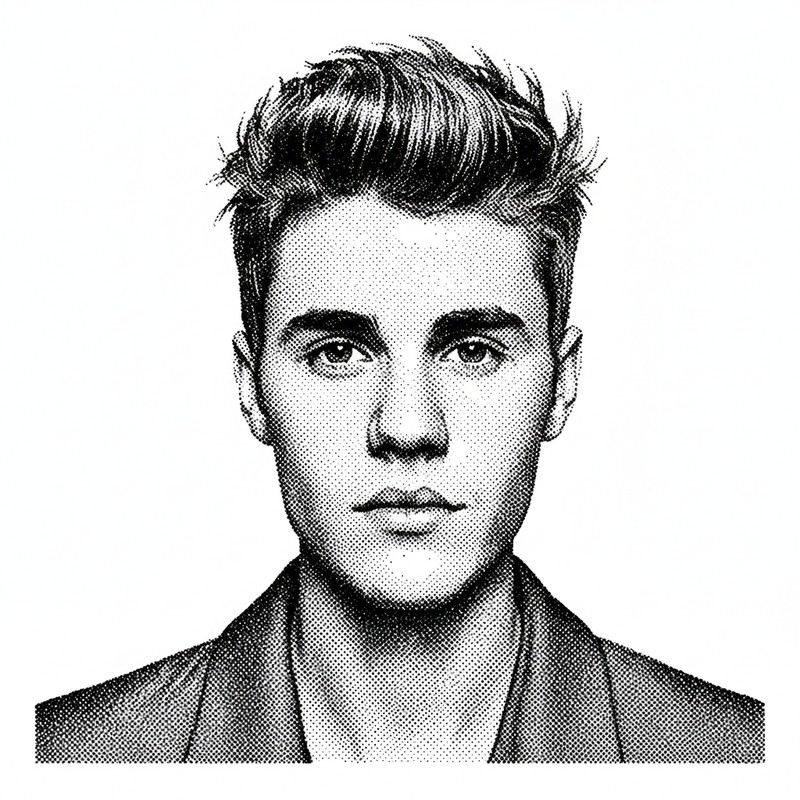
Case File #JB-2026-0223. Subject: Justin Drew Bieber. Filed under: Canadian Pop Stars; Individuals Mentored by Usher Raymond IV; Persons Who Have Said the N-Word on Camera More Than Once and Apologized Each Time.
The Board of Review has opened a formal evaluation into the N-Word Pass eligibility of Justin Drew Bieber, a Canadian national who was discovered on YouTube at the age of thirteen, mentored by one of R&B’s most respected artists, and subsequently spent the better part of a decade testing the structural limits of public goodwill. The question before the Board is whether Mr. Bieber’s deep and documented ties to Black music, Black mentors, and Black cultural spaces produce a sufficient foundation for pass issuance, or whether the recorded incidents of racial language and a broader pattern of cultural borrowing render the application unfulfillable.
The biographical record is relevant. Justin Bieber was born in London, Ontario, in 1994 and raised by his mother, Pattie Mallette, in Stratford, a town whose primary claim to cultural significance is an annual Shakespeare festival. Young Justin taught himself drums, piano, guitar, and trumpet with a natural musicality that even the Board’s most skeptical members acknowledge as genuine. In 2007, his mother began uploading videos of Justin singing R&B covers to YouTube. One of those videos was discovered by Scooter Braun, a talent manager who arranged a meeting with Usher Raymond IV in Atlanta. Usher, after hearing the thirteen-year-old sing, signed him to Raymond Braun Media Group and subsequently to Island Records.
This is where the cultural complexity begins. Usher did not offer Bieber a record deal from across a conference table. He took the kid under his wing. He mentored him. He brought him into Black musical spaces, introduced him to Black artists, and invested personal capital in shaping his artistic development. When Usher Raymond, a man with three decades of R&B credibility, decides to stake his reputation on a white teenager from Stratford, Ontario, that is not a casual business arrangement. It is something closer to cultural adoption.
What young Justin did with that adoption forms the substance of the evaluation before us today. The record is, to use the Board’s clinical assessment, inconsistent.
Cultural Context
The N-Word Pass, as our institution has documented, represents a form of communal trust that cannot be conferred by a single individual, regardless of that individual’s standing. Usher’s mentorship opened doors. It did not, and could not, automatically grant passage through them. The distinction matters because Mr. Bieber’s application leans heavily on the weight of his Black endorsements while the public record contains evidence that complicates those endorsements substantially.
The broader context is the long and frequently uncomfortable history of white artists in Black musical genres. From Benny Goodman claiming the title “King of Swing” to Elvis Presley’s complicated relationship with the Black musicians who influenced him, the pattern is well-documented: Black artists build a genre, a white artist arrives, the industry’s commercial machinery amplifies the white artist, and the originators receive credit that is inversely proportional to their influence. The Eminem evaluation examined this dynamic at length. The Post Malone case explored its modern streaming-era variation.
Bieber’s trajectory follows this pattern with certain modifications. He did not enter hip-hop through battle rap or underground credibility. He entered through YouTube, a platform that democratized access but also stripped the gatekeeping mechanisms that traditionally required artists to demonstrate cultural understanding before receiving cultural access. His entry was facilitated by a Black mentor, which distinguishes his case from the purely industry-manufactured pop-to-hip-hop pipeline. But facilitated entry and earned entry are different categories in the Board’s evaluation framework.
The Case For
The Usher Mentorship Is Not Performative
Usher Raymond’s investment in Justin Bieber began when Bieber was thirteen years old and has continued, in various forms, for over fifteen years. This is not a one-off collaboration or a strategic feature placement. Usher brought Bieber into his home. He introduced him to the business. He stood beside him during the period of peak public meltdown (roughly 2013 to 2015, a stretch that included egging a neighbor’s house, a DUI arrest, and a mugshot in which Bieber appeared to be having the time of his life) and continued to publicly support him afterward.
In the hierarchy of cultural endorsements, sustained personal mentorship from a figure of Usher’s stature carries significant weight. It suggests that Usher saw something beyond commercial potential: a genuine connection to the music and a teachable foundation. Our Board does not dismiss this lightly.
Genuine Musical Talent Rooted in R&B
Before the pop machine fully absorbed him, Justin Bieber demonstrated a vocal ability and rhythmic sensibility rooted in R&B tradition. His early YouTube covers of Ne-Yo, Chris Brown, and Usher himself were not karaoke-grade imitations. They showed instinctive phrasing, an understanding of runs and vocal ornamentation, and a feel for groove that cannot be entirely manufactured by producers. Albums like “Purpose” and “Justice” incorporated gospel, dancehall, and R&B elements with a fluency that, while not unassailable, exceeds the surface-level borrowing typical of pop crossover acts.
Collaborations Suggest Genuine Industry Relationships
Bieber’s collaborative record includes work with Ludacris, Big Sean, Quavo, Chance the Rapper, Travis Scott, Daniel Caesar, and Burna Boy, among others. These artists chose to work with him, and in the modern music industry, where Black artists have substantial leverage over their feature selections, repeated collaboration is a meaningful indicator that the subject is respected within those creative circles.
Public Acknowledgment of Influence and Gratitude
In multiple interviews, Bieber has credited Black artists and Black musical traditions as the foundation of everything he does. He has spoken publicly about the debt he owes to Usher, to R&B as a genre, and to the Black communities in Atlanta that shaped his early career. These acknowledgments, while not sufficient on their own, indicate an awareness of cultural lineage that some white artists in similar positions have failed to demonstrate.
The Case Against
The Recorded Incidents Are Disqualifying
This is the section the Board cannot avoid, and we will address it directly. In 2014, two separate videos surfaced of a teenage Justin Bieber using the N-word. In one, recorded when he was approximately fifteen years old, he tells a joke using the word with evident casualness. In another, he sings a parody of his own song “One Less Lonely Girl,” replacing “girl” with the N-word and referencing the Ku Klux Klan. He was approximately fourteen years old in the second recording.
Mr. Bieber apologized publicly, calling the recordings the result of ignorance and immaturity. He stated that he was not raised in an environment where he understood the weight of the word. Usher publicly supported him during the fallout, appearing visibly emotional in an interview where he described talking to Bieber about the history and pain embedded in the language.
The Board accepts that teenagers do profoundly stupid things. The Board also notes that these were not overheard private moments or ambiguous utterances. They were recorded performances, delivered with a comfort level that suggests the word was part of his casual vocabulary at the time. An apology addresses the aftermath. It does not erase the record. And the record shows a pattern: not a single slip, but multiple instances across multiple recordings. The Billie Eilish evaluation addresses similar questions about recorded incidents and the limits of age-based mitigation.
Cultural Tourism Masquerading as Cultural Engagement
Justin Bieber’s aesthetic evolution tracks suspiciously closely to whatever Black cultural trend is commercially dominant at the time. The swoopy hair and acoustic guitar era coincided with pop’s dominance. The dreadlocks, grills, and streetwear era arrived precisely when hip-hop became the industry’s primary revenue stream. The gospel-influenced “Purpose” era coincided with the mainstream embrace of Chance the Rapper and Kanye West’s “Ultralight Beam” moment. Each pivot was accompanied by corresponding fashion choices, slang adoption, and Instagram aesthetics drawn from Black culture.
Our Board does not question the sincerity of Bieber’s affection for these cultural elements. We question the pattern of adoption and abandonment that suggests a consumer relationship with Black culture rather than a committed one. When Black aesthetics are profitable, they appear in his visual identity. When the commercial wind shifts, so does the wardrobe.
The Appropriation-to-Apology Pipeline
Mr. Bieber has, at various points, worn dreadlocks, box braids, and other hairstyles drawn from Black cultural traditions. When criticized, he has alternately defended the choices, apologized for them, and then repeated them. This cycle, adopt, receive criticism, apologize, repeat, is a recognizable pattern that our Board has flagged in multiple evaluations. It suggests that the apologies are responsive rather than reflective: a public relations mechanism rather than evidence of evolving understanding.
Proximity Is Not Contribution
Dating Usher’s protege label, collaborating with Black artists, and being photographed at Black cultural events are forms of proximity. Our Board evaluates contribution. The record shows limited evidence of sustained institutional investment in Black communities. No scholarship programs. No community centers. No label infrastructure dedicated to elevating Black artists from underserved backgrounds. Mr. Bieber’s charitable work, while present, has not been targeted toward the Black communities whose cultural traditions form the foundation of his career in any systematic or sustained way.
Canadian Origin Complicates the Cultural Claim
This is not a disqualifying factor on its own, but it is a contextual one. The N-word carries a specifically American historical weight rooted in chattel slavery, Jim Crow, and ongoing systemic racism. Canada has its own history of anti-Black racism, but the cultural dynamics are different. Bieber’s formative years in Stratford, Ontario, did not expose him to the specific American racial landscape that gives the word its weight. His introduction to that landscape came through the music industry, not through lived experience. The Ryan Reynolds evaluation examines similar questions about Canadian origin and American cultural claims.
Deeper Analysis
The Justin Bieber case represents a specific and instructive category in the Board’s evaluation history: the white artist whose Black endorsements are genuine, whose talent is real, and whose personal record nonetheless contains disqualifying material that no volume of co-signs can override.
Usher’s mentorship is real. The musical talent is real. The industry relationships appear authentic. These are not fabricated credentials. But the evaluation framework does not operate on a point system where enough positive factors automatically cancel negative ones. The recorded incidents of racial language represent a specific type of failure: not a misunderstanding of the culture’s boundaries, but a demonstrated willingness to cross them when the social cost appeared to be zero. The fact that these recordings were made in the apparent absence of Black observers, in moments when Bieber seemed to believe no consequences would follow, is itself revealing. It suggests a compartmentalized relationship with the word: respectful in the presence of Black peers, casual in their absence.
This compartmentalization is precisely what the N-Word Pass is designed to evaluate. The pass is not a performance review conducted only during business hours. It is an assessment of how an individual relates to Black culture and Black language in all contexts, including the ones where nobody is watching. The recordings provide a window into the unwatched context, and what that window reveals is not consistent with the public persona.
The Board acknowledges that these recordings are over a decade old and that people, particularly people who were children at the time, can change. The Board also notes that change is best demonstrated through sustained action rather than periodic apology. Mr. Bieber’s subsequent career shows genuine musical growth and continued engagement with Black artists. It does not show the kind of sustained community investment, structural contribution, or public engagement with racial justice that would convince the Board that the transformation extends beyond the professional into the personal.
The Kim Kardashian evaluation demonstrates what sustained institutional investment looks like in the context of a pass application. The contrast with Mr. Bieber’s record is instructive.
Official Verdict
DENIED. The Board of Review has determined that Justin Drew Bieber does not meet the criteria for issuance of the Official N-Word Pass.
The determining factors are as follows: multiple recorded instances of casual use of the N-word, documented on video and released publicly, constitute a pattern of behavior that exceeds the threshold for single-incident mitigation; the cycle of cultural adoption, criticism, apology, and repetition suggests a consumer rather than contributory relationship with Black culture; and the absence of sustained institutional investment in Black communities indicates that Mr. Bieber’s engagement, while commercially deep, lacks the structural reciprocity our framework requires.
Mitigating factors are entered into the record: the Usher mentorship represents a genuine and sustained cultural endorsement of significant weight; musical talent rooted in R&B tradition is acknowledged; and collaborative relationships with Black artists suggest authentic professional respect. These factors, while substantial, are insufficient to overcome the disqualifying elements identified above.
This denial is not permanent. Should Mr. Bieber establish sustained community investment, demonstrate continued personal growth through action rather than apology, and maintain the pattern of respectful collaboration that characterizes his better professional relationships, a future review may reach a different conclusion. For now, the application is denied with the recommendation that the subject continue learning from his mentor, who clearly has more to teach him.