Introduction
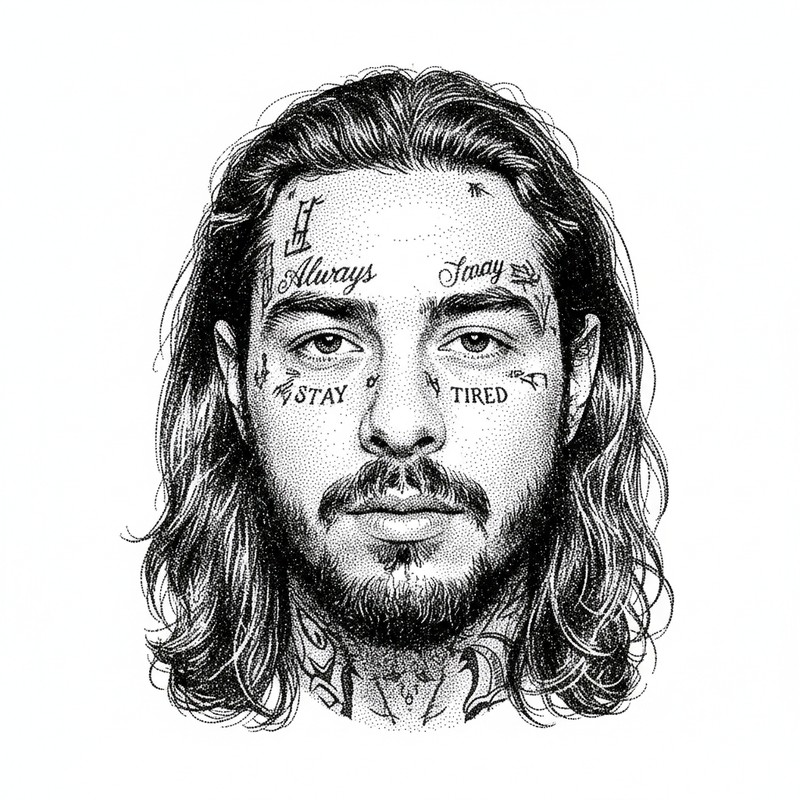
Our Board of Review has convened to examine the case of Austin Richard Post, known professionally as Post Malone, known culturally as “that guy who looks like he smells exactly the way you think he smells but is apparently very nice in person.” The Official N-Word Pass evaluation process demands thoroughness, and we intend to deliver it. The question before us today is one that has generated substantial debate across social media, music forums, and at least three separate Reddit threads with over 2,000 comments each: does Post Malone have the N-Word Pass?
Let us begin with the biographical record. Austin Post grew up in Grapevine, Texas, a suburb of Dallas where the most culturally significant landmark is a mall and the most common form of artistic expression is a yard sign announcing support for the high school football team. His stepfather managed concessions for the Dallas Cowboys, which gave young Austin access to stadium events but not, our Board notes, to the kind of formative cultural immersion that typically precedes a pass application.
Austin’s origin story involves a Guitar Hero obsession that led to actual guitar playing, a rap name generated by an online random name generator (a fact confirmed by the subject himself in multiple interviews), and a post-graduation move to Los Angeles where he lived in a house called the “White Iverson Compound” and survived on Hot Pockets. In July 2015, he uploaded “White Iverson” to SoundCloud, and the internet did what the internet does when a catchy song arrives: it went feral. Millions of plays. Retweets from Wiz Khalifa and Mac Miller. A record deal with Republic Records. An appearance at Kylie Jenner’s birthday party, which is apparently a career milestone now.
What followed was a run of commercial success that would make most artists weep with gratitude: “Congratulations,” “Rockstar” (featuring 21 Savage), “Circles,” and three multi-platinum albums. Post Malone became one of the biggest artists on the planet, performing at festivals, collecting Grammy nominations, and cultivating a personal brand that can best be described as “medieval knight who discovered weed and never looked back.”
But commercial success is not what our Board evaluates. We evaluate cultural standing, reciprocity, and trust. And on those metrics, Post Malone’s application encounters significant complications.
Cultural Context
The N-Word Pass, as our institution has documented extensively, represents a form of cultural trust that cannot be purchased, streamed, or awarded by a record label. It emerges from genuine relationships, sustained engagement, and a demonstrated understanding of the weight that the word carries.
Post Malone’s relationship with hip-hop is, to use a technical term from our evaluation framework, complicated. He entered the genre through a song named after a Black basketball icon (Allen Iverson), built on production aesthetics pioneered by Black producers in Atlanta, and delivered with vocal stylings borrowed from the Auto-Tune tradition that T-Pain popularized and Future perfected. None of this is inherently disqualifying. Cultural exchange is how genres evolve. The question is whether the exchange is reciprocal or extractive.
The broader context matters here. We exist in what sociologists call a “post-genre” moment, where streaming platforms flatten musical categories and a single artist can chart simultaneously in hip-hop, pop, and country. Post Malone is perhaps the most visible beneficiary of this flattening. He raps on one track, croons on the next, covers Nirvana at a tribute concert, and releases a country album that debuts at number one. This flexibility is, in one reading, a celebration of musical fluidity. In another reading, it is a demonstration of the privilege that allows a white artist to move between genres without the friction that Black artists face when attempting the same maneuvers.
The Eminem evaluation examined similar questions about white artists in Black musical spaces, but Eminem’s case differs in a critical respect: Marshall Mathers was forged in the specific cultural furnace of Detroit’s underground rap scene. Post Malone was forged in a suburban Texas bedroom with a WiFi connection. Our Board does not assign moral value to geography, but we do note that the pathways to cultural credibility are not identical.
The Case For
”White Iverson” Acknowledged Its Source Material
Post Malone did not name his breakout song “White Iverson” by accident. Allen Iverson represented a specific ethos within Black culture: defiance of respectability politics, authenticity over conformity, and the refusal to dress how the NBA wanted him to dress. By naming his song after Iverson and explicitly framing himself as a white parallel to that ethos, Post demonstrated at minimum an awareness of the cultural lineage he was drawing from. He did not pretend to have invented the aesthetic. He named his debt directly, and our Board notes that acknowledgment.
Collaboration List Suggests Genuine Industry Relationships
After extensive evaluation of his discography, our Board notes collaborations with 21 Savage, Quavo, Future, Lil Baby, Doja Cat, Swae Lee, Ty Dolla $ign, and Roddy Ricch, among others. These are not charity features. In the modern music industry, an artist’s collaboration list is a reasonable proxy for who actually wants to be in the studio with them. The consistency and breadth of Post’s Black collaborators suggests that, within the industry at least, he is regarded as a genuine and respectful creative partner.
Public Support During 2020 Protests
During the 2020 racial justice protests following the murder of George Floyd, Post Malone donated to relief funds, distributed supplies at rallies in Salt Lake City, and used his platform to amplify Black Lives Matter messaging. Our Board notes these actions favorably while also noting (see “Case Against”) that crisis-moment activism and sustained community engagement are different categories of contribution.
Genre Bridge Introduces Audiences to Black Artists
The “gateway drug” argument has some merit. Teenagers who discovered 21 Savage through “Rockstar” may have gone on to explore 21’s solo catalog, which deals with immigration, poverty, and survival in ways Post’s music does not. Post has consistently credited his Black collaborators in interviews, describing them in terms that suggest genuine admiration rather than performative respect.
Industry Reputation for Personal Decency
Our Board has reviewed numerous accounts from tour staff, venue workers, and fellow artists describing Post Malone as genuinely kind, generous with tips and time, and respectful in professional settings. While personal decency is not a sufficient condition for pass issuance, it is noted as a positive indicator of character.
The Case Against
The 2017 Comments About Hip-Hop’s Emotional Depth
In a 2017 interview with the Polish outlet NewOnce, Post Malone stated: “If you’re looking for lyrics, if you’re looking for people to actually respect you for what you say, come to me. Don’t listen to hip-hop.” He further suggested that hip-hop rarely “makes you feel something.” Our Board has reviewed the full transcript and the subsequent apology video.
The statement is disqualifying on its own terms. Hip-hop is, at its foundation, a storytelling art form built by Black communities to express experiences that mainstream culture refused to acknowledge. To suggest that the genre lacks lyrical substance or emotional depth is to demonstrate a fundamental misunderstanding of the very culture you are profiting from. Saying this while having built your career on hip-hop production aesthetics and hip-hop audience infrastructure is, to use our Board’s clinical assessment, spectacularly bad. The apology was noted. It was also delivered via shaky Instagram video, which is the 2017 equivalent of a text message breakup.
Unresolved Questions About Past Usage
Digitally unearthed footage allegedly captures a teenage Post using the N-word while singing along to Chief Keef’s “Love Sosa.” His management team responded by claiming they could not verify the clip. Our Board notes that “we cannot verify the clip” is not the same as “it didn’t happen.” The absence of a direct denial leaves an open question that works against the application.
Aesthetic Borrowing Without Historical Engagement
Post Malone has, at various points in his career, worn cornrows, gold fronts, and face tattoos while performing over trap beats and Atlanta-influenced production. These aesthetic choices are drawn from Black cultural traditions that carry specific historical weight. Our Board observes that Post has rarely engaged publicly with the history or significance of these aesthetics beyond wearing them. The Ariana Grande evaluation addresses similar questions about aesthetic borrowing and the obligations that accompany it.
Minimal Thematic Engagement with Black Issues
Post Malone’s discography is thematically organized around heartbreak, substance use, existential fatigue, and the loneliness of fame. These are legitimate artistic subjects. They are also subjects that carry no racial specificity. In a genre built on Black narrative, Post’s consistent avoidance of any engagement with the systemic issues that affect Black communities (the same communities whose musical traditions fuel his career) reads as either deliberate avoidance or genuine indifference. Neither interpretation strengthens his case.
Philanthropy Lacks Institutional Commitment
Post Malone’s charitable contributions tend to surface during moments of national crisis and then recede from public view. Our Board notes no long-term scholarship programs, no youth centers, no label imprints dedicated to underserved communities, and no sustained institutional investment in Black community infrastructure. Compare this to the pattern established in the Kim Kardashian evaluation, where sustained institutional investment was a significant factor in a favorable verdict. Crisis donations are appreciated. They are not the same as structural commitment.
Deeper Analysis
Our Board of Review has determined that the Post Malone case represents a specific and increasingly common category: the white artist who genuinely loves hip-hop, who is genuinely liked by his Black collaborators, who is by all accounts a genuinely decent person, and who nonetheless has not demonstrated the depth of cultural understanding, sustained reciprocity, or structural engagement that our evaluation criteria require.
This is not a character indictment. Post Malone is, by the available evidence, a good dude. He tips well. He hugs people. He gives away guitars. These are admirable qualities in a human being. They are insufficient qualifications for the N-Word Pass.
The core issue is asymmetry. Post Malone moves between hip-hop, pop, and country with a fluidity that is available to him in part because of his race. A Black artist attempting the same genre-hopping would face different industry resistance, different audience expectations, and different critical frameworks. This differential privilege is not something Post created, but it is something he benefits from, and our evaluation criteria require applicants to demonstrate awareness of and active engagement with the structural advantages they receive.
The 2017 comments about hip-hop’s emotional depth revealed a gap between proximity and understanding. You can love a culture’s sounds, collaborate with its artists, and profit from its audience infrastructure while still fundamentally misunderstanding what the culture is about. That gap, more than any single incident, is what our Board finds most relevant to this evaluation.
Official Verdict
DENIED. Our Board of Review has determined that Austin Richard Post, known professionally as Post Malone, does not meet the criteria for issuance of the Official N-Word Pass.
The determining factors are as follows: the 2017 statements dismissing hip-hop’s lyrical and emotional substance demonstrate insufficient understanding of the culture’s foundations; the absence of sustained institutional investment in Black communities indicates a pattern of crisis-response philanthropy rather than structural commitment; unresolved questions about past usage remain unaddressed by a direct denial; and aesthetic borrowing without corresponding historical engagement suggests surface-level cultural participation.
Mitigating factors are noted: genuine industry relationships, a collaborative record that suggests real respect from Black peers, and personal conduct that is by all accounts decent and generous. These factors are entered into the record but are insufficient to overcome the deficiencies identified above.
This denial is not permanent. Our Board’s evaluations are subject to revision based on demonstrated change. Should Post Malone establish sustained community investment, engage more deeply with the cultural history of the genres he profits from, and continue the pattern of respectful collaboration that characterizes his best work, a future review may reach a different conclusion. For now, the application is denied with respect.